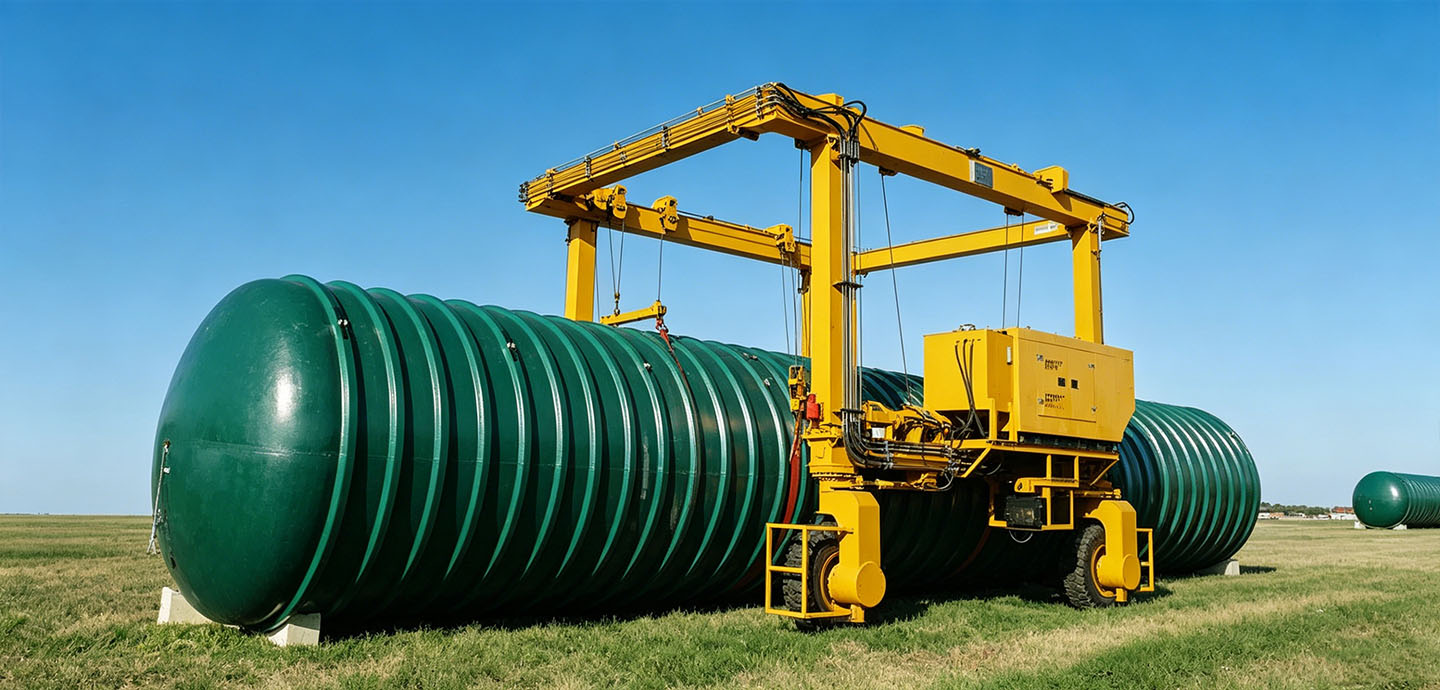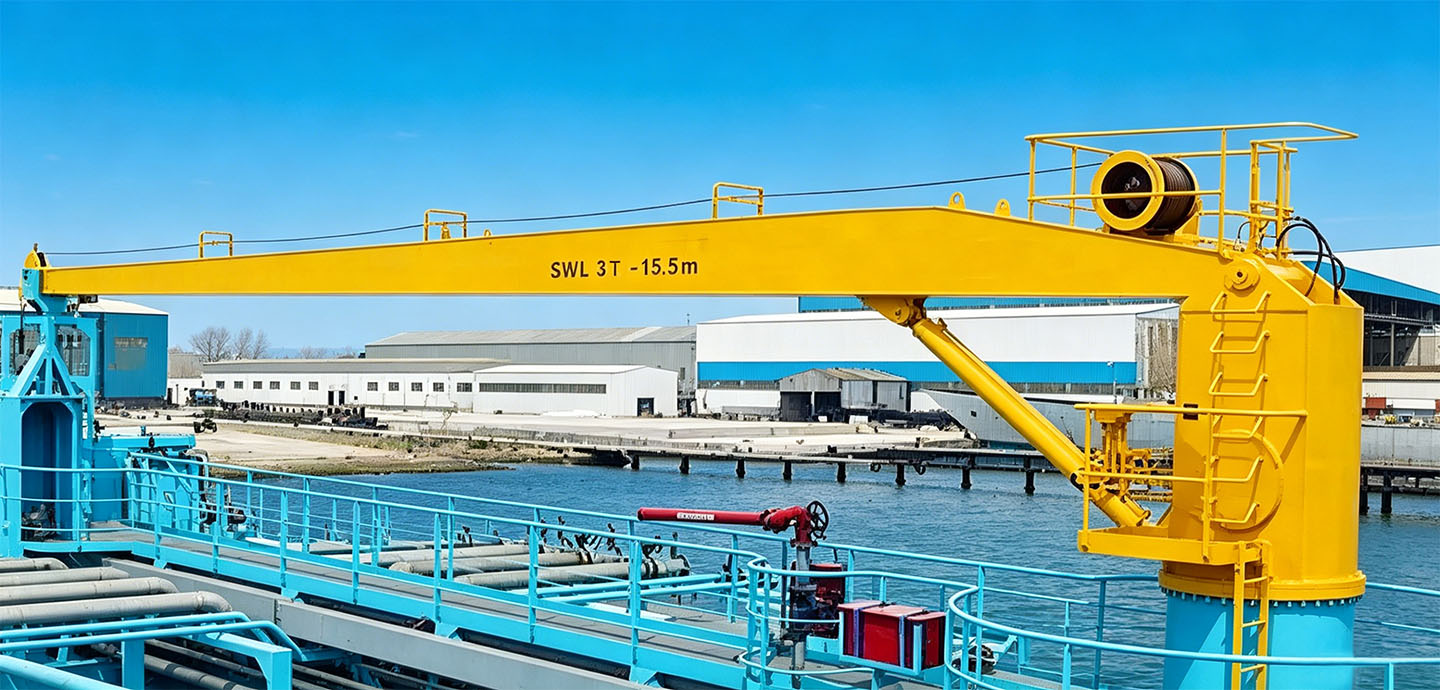
As a core equipment in the fields of heavy-duty handling, the Rubber Tire Gantry Crane plays an irreplaceable role in scenarios such as manufacturing and industrial plants, thanks to its flexible mobility without the constraint of tracks. Compared with traditional rail-mounted gantry cranes, the rubber tire gantry crane uses rubber tyres as the traveling medium, enabling free expansion of the working area and significantly enhancing the efficiency and adaptability of material handling. This article will comprehensively analyze the operation mechanism and practical value of this high-efficiency lifting equipment, starting from its basic composition, core working principles, remarkable advantages, and typical application scenarios.
The efficient operation of a rubber tire gantry crane depends on the coordinated cooperation of its core components. Each component undertakes specific functions, jointly ensuring the equipment’s stability, mobility, and lifting capacity. Its main components include the following key parts:
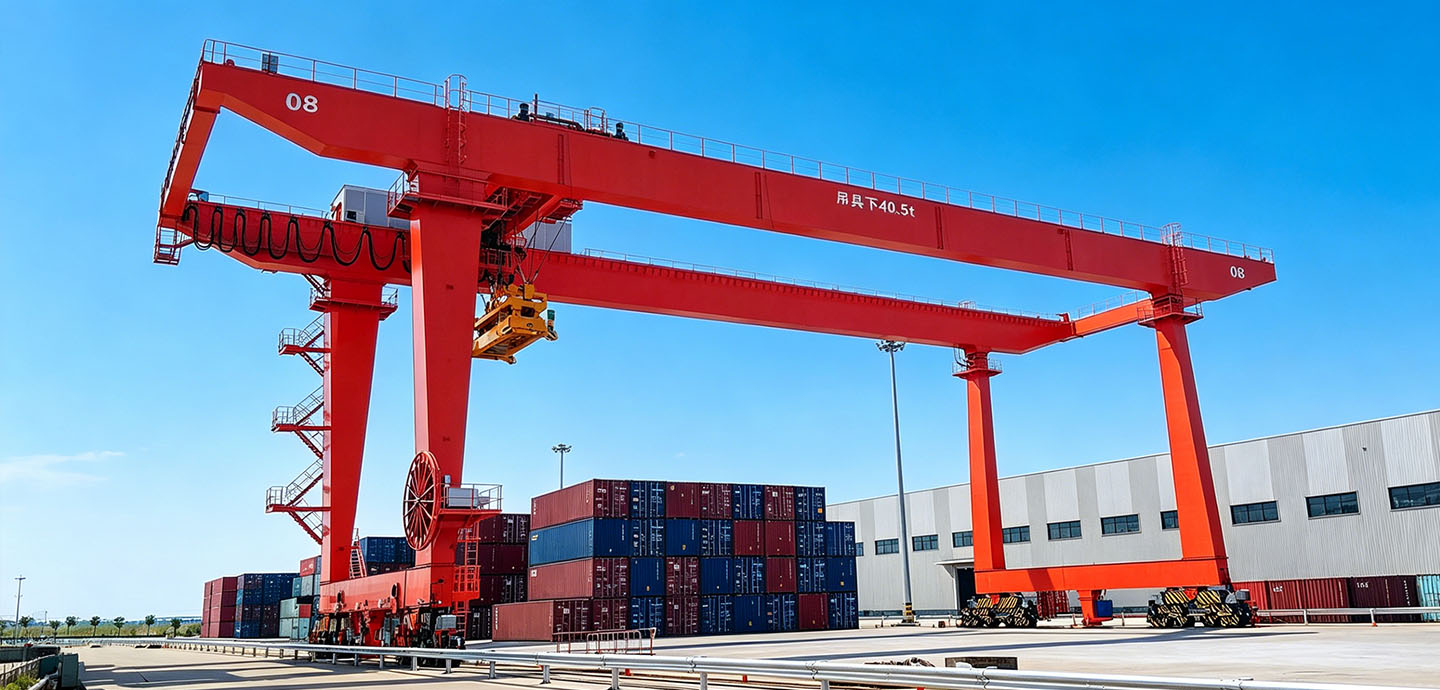
The main girder is the horizontal load-bearing core of the rubber tire gantry crane, usually welded from high-strength steel, spanning the width direction of the crane. As the primary structure for bearing loads, the main girder must possess extremely high bending and torsional resistance to ensure that it does not deform or break when lifting heavy objects. Its length and cross-sectional design need to be accurately calculated according to parameters such as the crane’s rated lifting capacity and span, while also balancing lightweight and structural strength.
Support legs are vertical structures that connect the main girder to the tire-based traveling system at the bottom, and they are crucial for ensuring the overall stability of the crane. They are typically designed as gantry-style double-leg or four-leg configurations. Inside the legs, components such as tire-driving devices and steering mechanisms are integrated.
The hoisting mechanism is the core system for achieving the lifting and lowering of goods, consisting of a motor, reducer, drum, wire rope or chain, and hook (or spreader). During operation, the motor drives the drum to rotate through the reducer, causing the wire rope to wind or unwind, thereby driving the spreader to rise or fall. To ensure smooth hoisting, some rubber tire gantry cranes are also equipped with a variable-frequency speed-control system and a braking device, which can precisely control the lifting and lowering speed and enable emergency braking in case of emergencies.
The trolley moves horizontally along the track on the main girder, driving the hoisting mechanism to move freely within the span of the main girder, achieving the horizontal displacement of the load. The driving mode of the trolley is usually motor-gear transmission, and its running accuracy directly affects the positioning accuracy of the goods. The trolleys of some rubber tire gantry cranes are also equipped with anti-sway devices to reduce the swing of the goods during movement and enhance operational safety.
Rubber tyres are the iconic components that distinguish rubber tire gantry cranes from rail-mounted cranes. Usually, large-sized, high-load-bearing industrial tyres are used, with a single-tyre load-bearing capacity of several tons. The number of tyres is designed according to the weight and stability requirements of the crane, with common configurations of 4-wheel, 8-wheel, or 16-wheel. The tyre material and tread pattern are specially optimized to adapt to various ground surfaces such as asphalt and concrete, while also having good wear-resistance and shock-absorption properties.
The operator’s cab is the control center of the crane, equipped with control devices such as joysticks, displays, and buttons inside. Operators can precisely control each action of the crane through these devices. The operator’s cab of rubber tire gantry crane is usually located on one side of the main girder or on the upper part of the support leg, providing a broad view for the operator to observe the goods and the working environment. Some rubber tire gantry cranes can be operated remotely through a remote-control system.
There are mainly three types of power sources for rubber tire gantry crane:
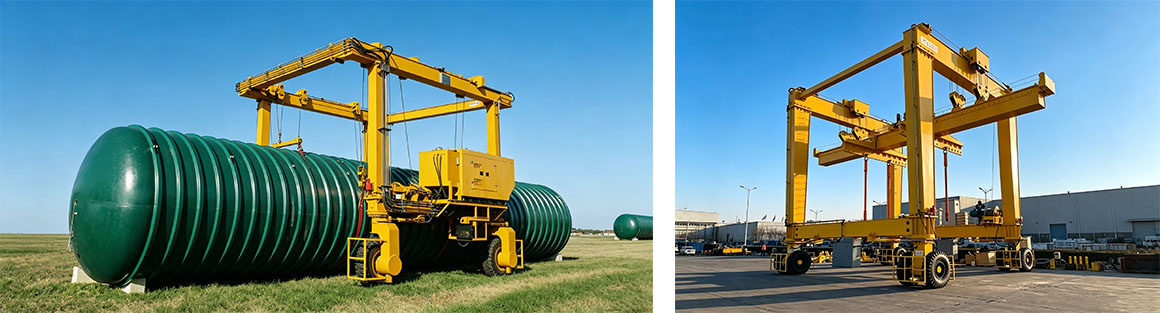
The working process of a rubber tire gantry crane is the result of the coordinated operation of mechanical, hydraulic, and electrical control system. Its core principle is to achieve precise material handling through the orderly linkage of various mechanisms. Specifically, it can be divided into the following key steps:
The traveling system of the rubber tire gantry cranes, consisting of tyres, drive motors, steering mechanisms, and a control system, is the core that realizes its “track-less” advantage. During operation, the operator issues a movement command through the joystick in the operator’s cab or a remote-control system. After receiving the signal, the electrical control system drives the motor to rotate the tyres through a reducer, moving the crane in the specified direction.
The steering mechanism adjusts the deflection angle of the tyres through hydraulic or electric means, enabling the crane to move straight, turn, move diagonally, or even rotate in place (supported by some models). For example, in construction site, the rubber tire gantry crane needs to shuttle between yards. At this time, the steering system can precisely control the angle of each tyre, ensuring that the equipment can turn flexibly in a narrow space and accurately dock at the location of the target destination.
During the traveling process, speed sensors and position sensors continuously feedback the operating status of the equipment. The control system adjusts the speed and direction according to the preset path or the operator’s instructions to avoid collisions with other equipment or goods.
When the rubber tire gantry crane reaches the work point, the hoisting mechanism starts to operate. The process is as follows:
The lowering process is similar to the lifting process. The motor rotates in the opposite direction to release the wire rope, and the spreader drives the goods to descend slowly. It automatically decelerates when approaching the placement point to achieve a smooth landing.
After the goods are lifted to a safe height, the trolley mechanism starts to operate. The trolley moves laterally along the track on the main girder, transporting the goods from the current position to above the target position or transportation vehicle (such as a truck or train).
The driving mode of the trolley is usually gear-rack transmission or wire-rope traction, powered by a variable-frequency motor, enabling stepless speed regulation. During the movement, the anti-sway system controls the acceleration and deceleration rhythm of the trolley or uses a hydraulic damping device to suppress the swing of the goods, ensuring that the goods remain stable during lateral movement and avoiding collisions with surrounding objects.
When the goods reach the target position above, the hoisting mechanism starts again to slowly lower the goods to the preset height (such as the top layer of the stack or the loading surface of the transportation vehicle). During the placement process, the sensors on the spreader detect the distance between the goods and the contact surface, and automatically decelerate when approaching to ensure a smooth landing.
If stacking operations are carried out, the control system of the rubber tire gantry crane will, in combination with the three-dimensional coordinate information of the yard, precisely control the lowering position of the goods to ensure neat and stable stacking. Some rubber tire gantry cranes can also use laser scanning or visual recognition technology to adjust the position in real-time to compensate for the impact of uneven ground or stacking deviation.
After the goods are placed, the locking device of the spreader automatically releases, and the hoisting mechanism raises the spreader to a safe height, waiting for the next operation instruction.
The electrical control system is the “brain” of the rubber tire gantry crane, responsible for coordinating the actions of various mechanisms to ensure safe and efficient operation. Its core functions include:
The control systems of rubber tire gantry cranes mostly use PLC (Programmable Logic Controller) and touch-screens, supporting functions such as parameter setting, fault diagnosis, and operation recording. Some high-end models also have remote monitoring and intelligent scheduling capabilities and can be connected to the terminal management system to achieve the coordinated operation of multiple rubber tire gantry cranes.
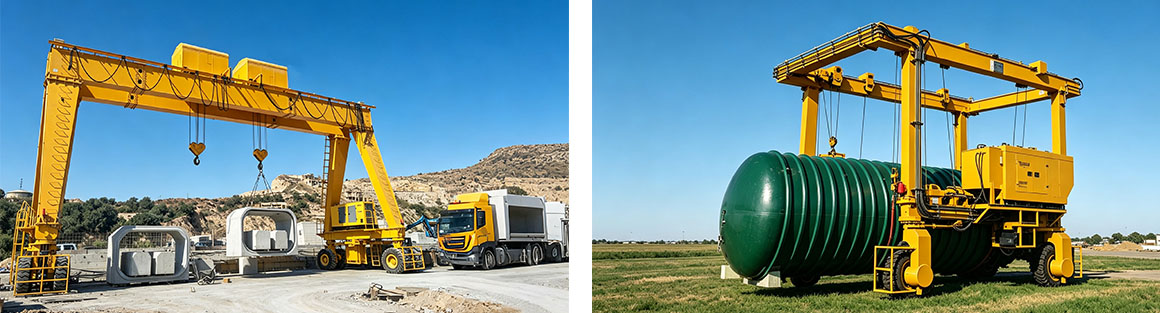
The rubber tire gantry crane is widely used in fields such as manufacturing and steel industry due to its unique performance advantages, as follows:
Rubber tire gantry cranes do not rely on fixed tracks and can move freely on flat ground (such as asphalt and concrete). Their working range is not restricted by tracks. This characteristic enables them to quickly adapt to changes in the working scenario. In addition, their steering systems support multi-angle turning, allowing them to complete maneuvers such as turning around and shifting in narrow spaces, further enhancing their environmental adaptability.
The lifting capacity of rubber tire gantry cranes is customized for actual work requirements, and some large-sized models can reach over 1000 tons. They can be used to handle various goods such as steel products, and large-scale equipment. By changing different spreaders (such as spreaders, hooks, grabs), they can also adapt to the handling of bulk goods (such as coal, ore) and general cargo, achieving “multi-purpose in one machine” and reducing equipment investment costs.
Rubber tire gantry cranes are equipped with a complete safety protection system, including:
These safety devices ensure the stable operation of rubber tire gantry cranes in complex working environments and reduce the risk of accidents.
Rubber tire gantry cranes adopt a modular design, and each core component (such as the hoisting motor, traveling motor, control system) can be independently disassembled and replaced, facilitating daily maintenance and fault repair. At the same time, the rubber tire gantry crane is equipped with a condition-monitoring system that can diagnose the operating status of components such as motors, reducers, and tyres in real-time, providing early warnings of potential faults and reducing downtime. Compared with rail-mounted cranes, rubber tire gantry cranes do not require track maintenance, reducing the maintenance cost of infrastructure.
With its flexibility, high efficiency, and adaptability, the rubber tire gantry crane has been widely used in multiple fields and has become an indispensable key equipment in industrial production.
In large industrial plants (such as steel mills, and automobile manufacturing plants), rubber tire gantry cranes are used to handle heavy raw materials, components, or finished products. For instance, in a steel mill, it can transport raw materials such as steel coils and steel plates. Its high lifting capacity and precise positioning ability can meet the strict requirements of heavy-duty goods handling in industrial production, enhancing the continuity and efficiency of the production process.
Rubber tire gantry cranes are widely used in the steel industry and are favored for their flexibility and efficiency. Its main function is to handle heavy steel, steel coils and other materials, which greatly improves production efficiency. In addition, the rubber tire gantry crane has a high lifting capacity and stability, which can meet the strict requirements of the steel industry for heavy object handling. The design of this crane also takes safety into account, equipped with a variety of safety devices to ensure the safety of operators and equipment. Overall, rubber tire gantry cranes are important equipment for the steel industry to achieve automation and enhance production efficiency.
Rubber tire gantry cranes play a crucial role in the wind power industry and are mainly used for the transportation and installation of large-scale wind power equipment. Its mobility flexibility enables the crane to operate efficiently in complex construction environments, especially in the narrow or uneven areas of wind farms. This crane has a high lifting capacity and stability, capable of safely transporting heavy wind turbine blades, towers and other components, significantly enhancing construction efficiency. In addition, the tire-type design enables it to be quickly transferred to different operation points, reducing assembly time and labor costs.
The rubber tire gantry crane, by integrating mechanical structures, hydraulic transmissions, and electrical control technologies, has realized track-less and efficient material-handling operations. Its core advantages lie in its flexible traveling ability, precise lifting control, and wide adaptability, enabling it to play an irreplaceable role in scenarios such as manufacturing, steel mills, and industrial plants.
With the development of automation and intelligent technologies, modern rubber tire gantry cranes are evolving towards unmanned operation, low-emission, and high-coordination directions. For example, through technologies such as 5G remote control, laser navigation, and AI-based visual recognition, the operational efficiency and safety are further enhanced. In the future, rubber tire gantry crane will continue to serve as the core equipment in heavy-duty handling fields, providing solid support for the efficient operation of the global supply chain.