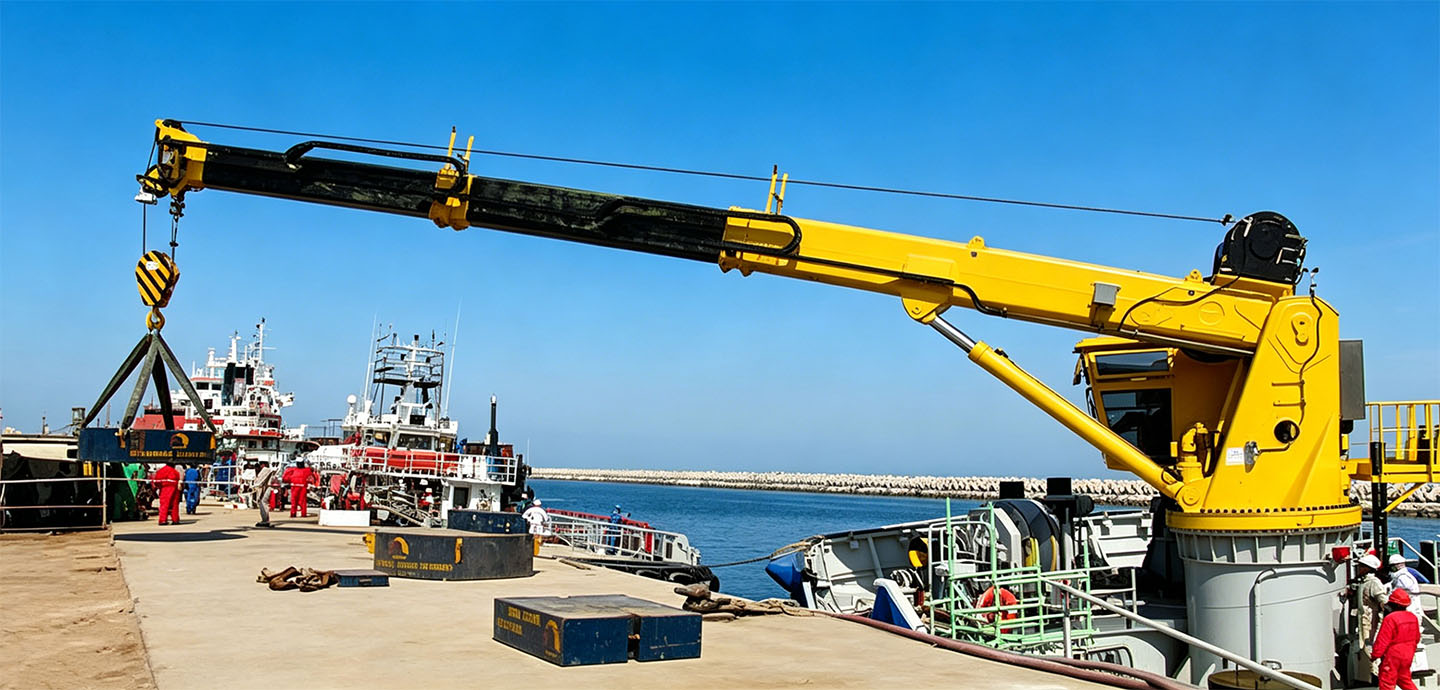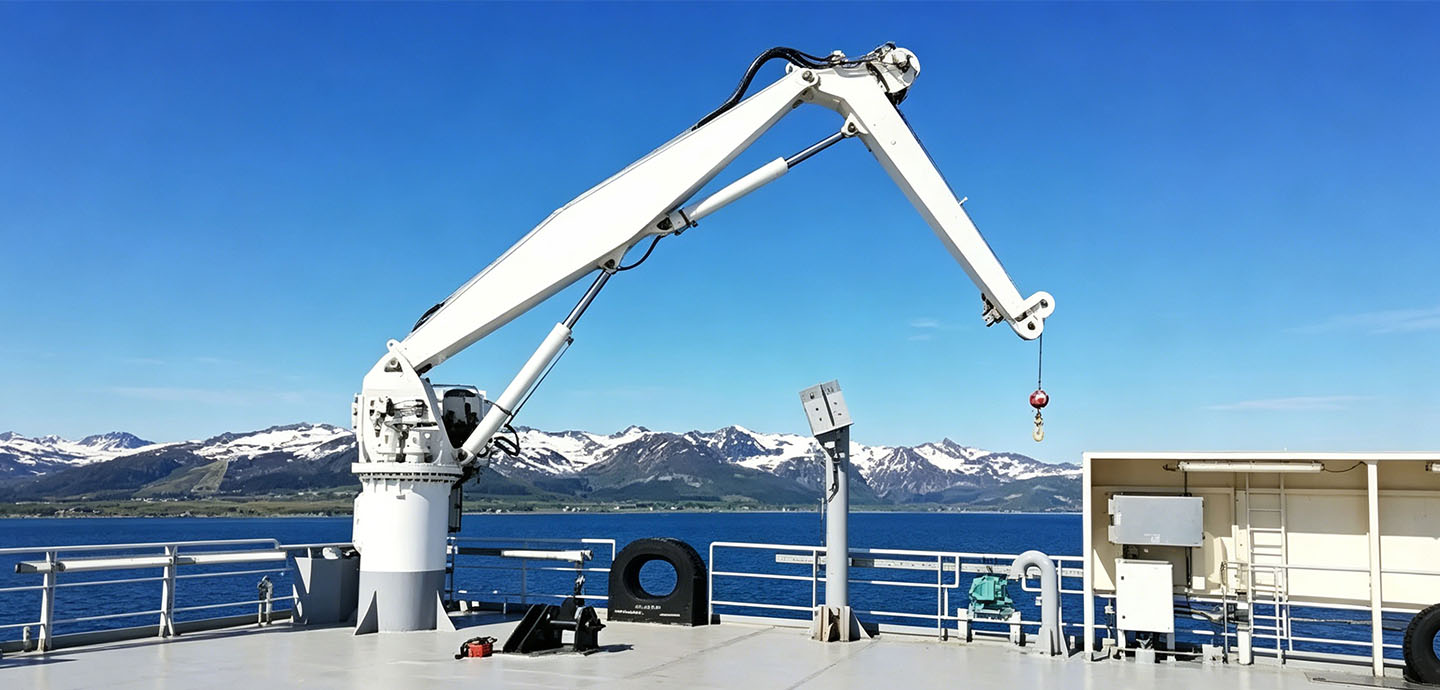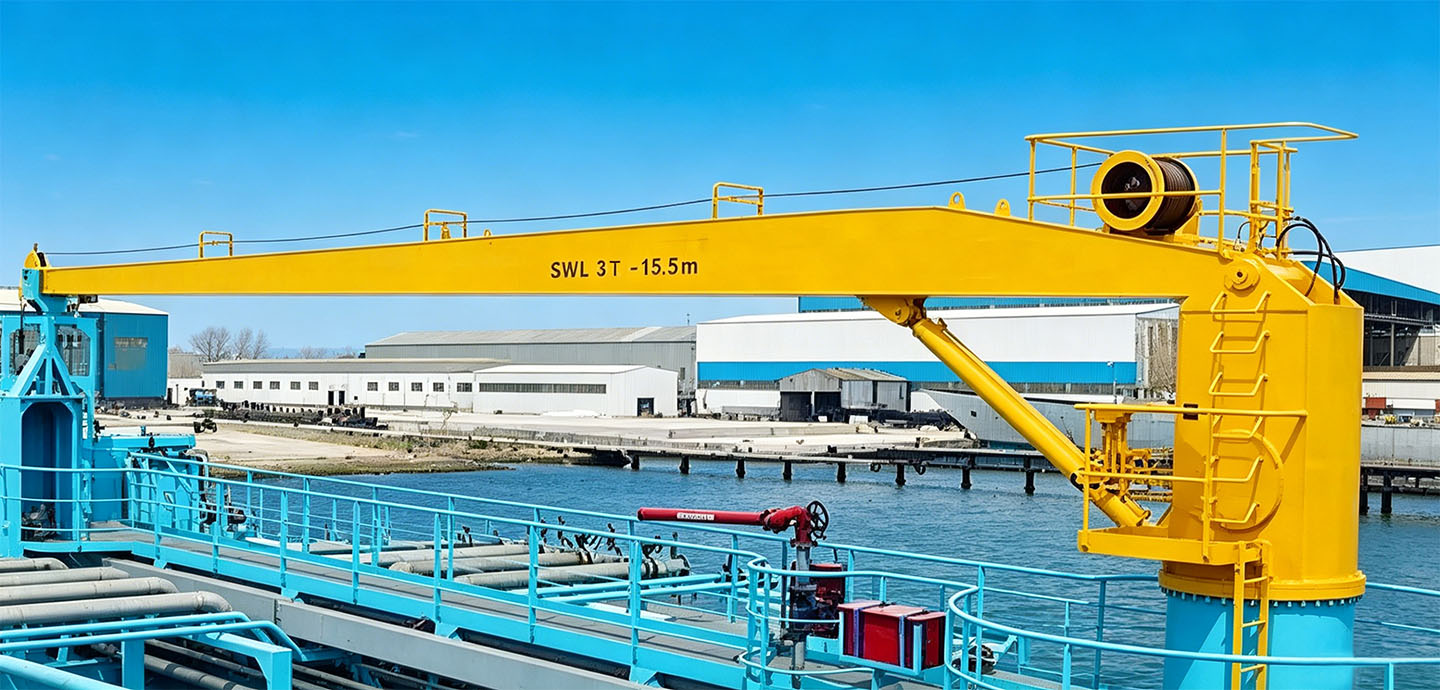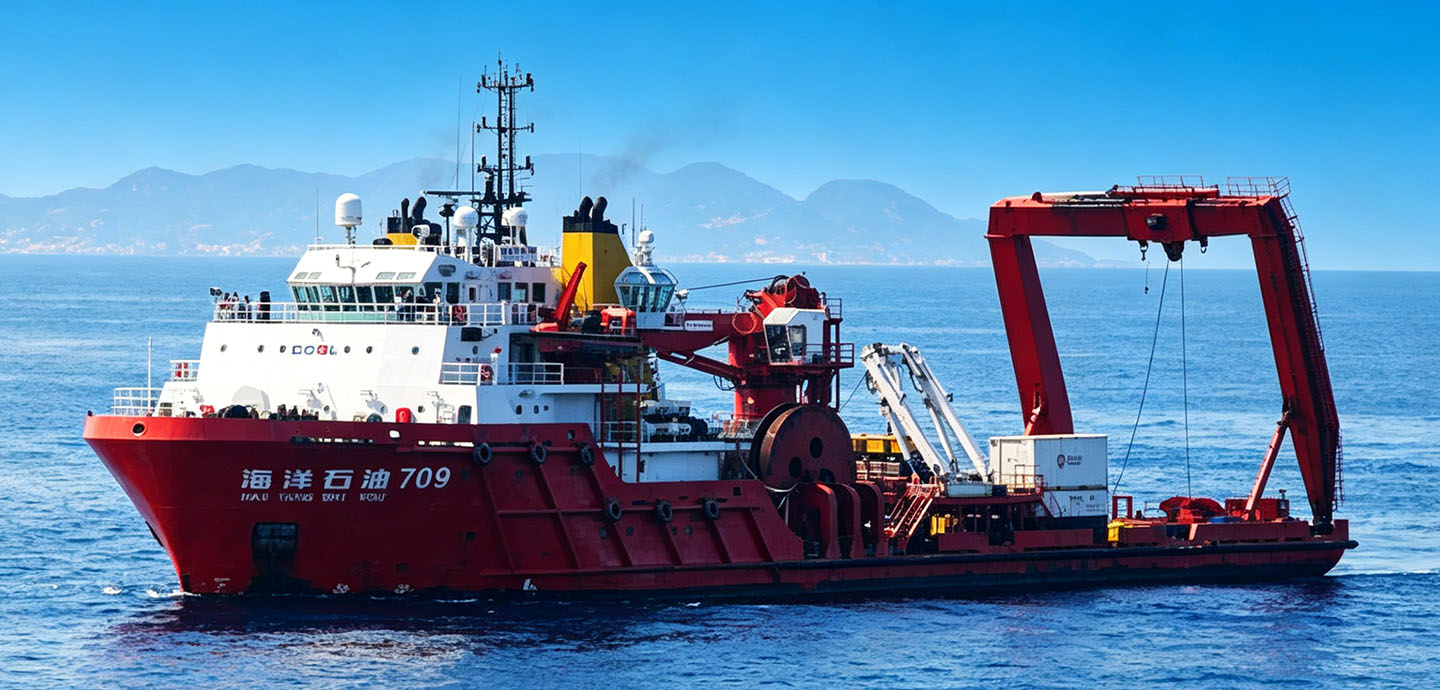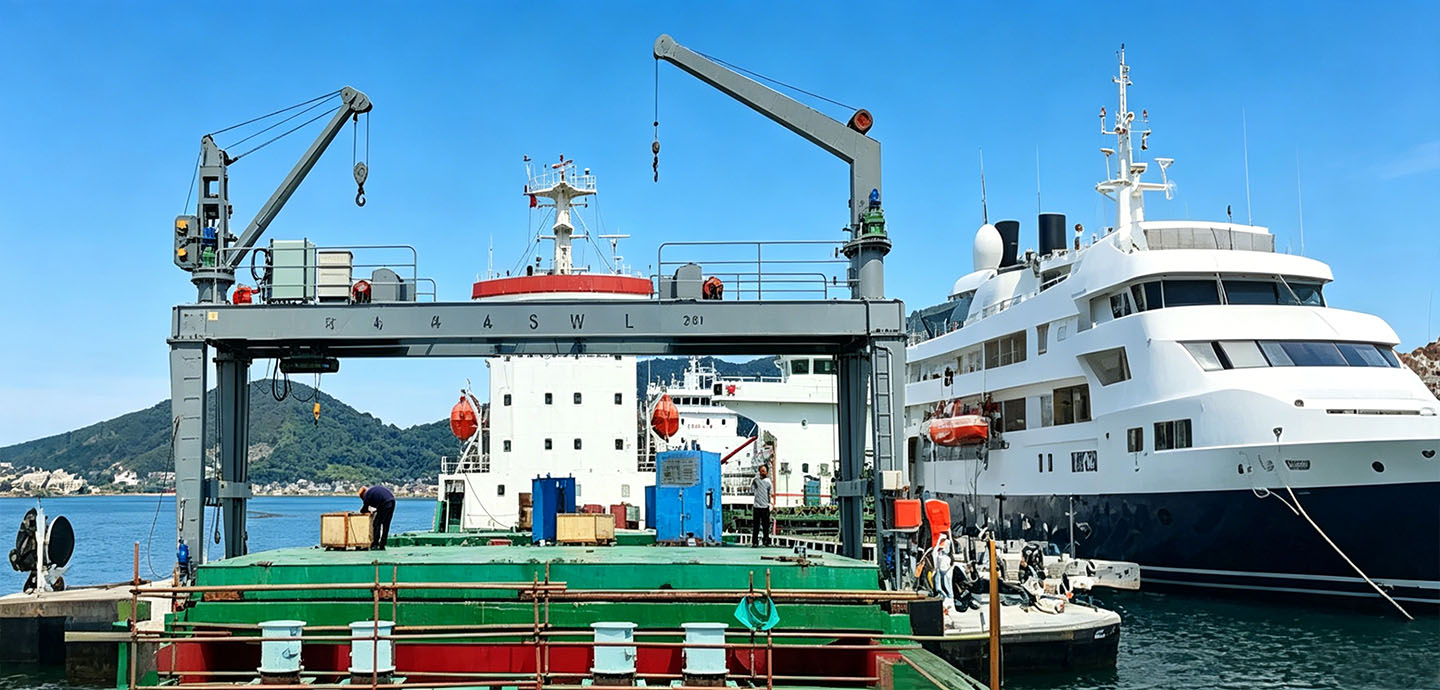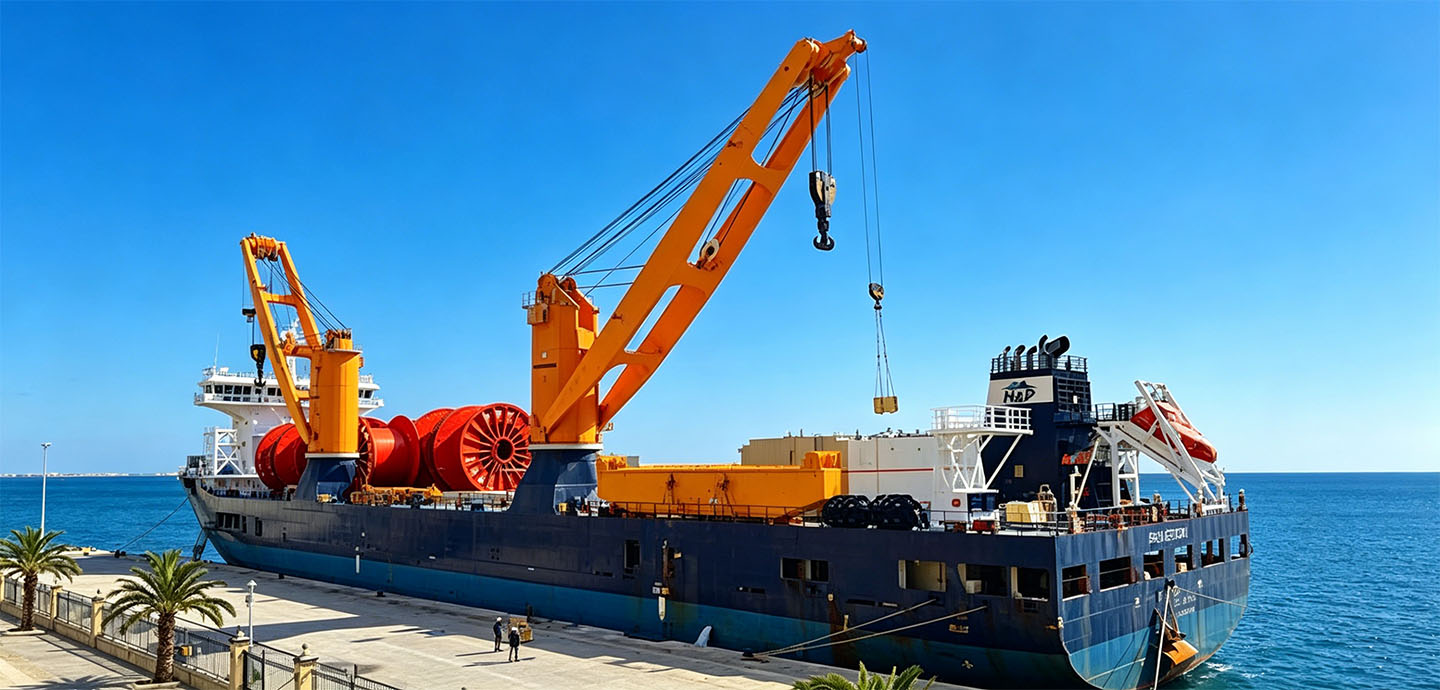
Marine cranes are used to lift and move cargo to different locations during vessel loading and unloading, equipment handling, offshore supply, maintenance and other operations. In actual operation, the weight a crane can lift is not fixed. It changes depending on the working radius.
A crane may be capable of lifting heavier loads when operating close to its slewing center. As the boom extends outward and the working radius increases, the allowable lifting capacity generally decreases. This change is related to several factors, including boom structure, load moment, hydraulic system performance and the overall load-bearing capacity of the crane.
For those purchasing or operating a marine crane, understanding these factors helps determine whether the equipment can meet lifting requirements throughout its actual working range, rather than focusing solely on its maximum rated lifting capacity.
The working radius refers to the horizontal distance between the crane’s slewing center and the vertical centerline of the suspended load. It determines how far the crane can reach to handle cargo and is an important parameter when assessing the allowable lifting capacity at different working positions.
When the load weight remains unchanged, a larger working radius generates a greater moment acting on the crane. The crane must withstand not only the weight of the load itself but also the moment created by the load and its horizontal distance from the slewing center.
Under simplified conditions, the load moment can be understood using the following formula:
M = W × R (where M is the load moment, W is the lifting load, and R is the working radius)
For example, when a crane lifts a 10 ton load at a working radius of 5 meters, the resulting load moment is 50 (t·m). If the working radius increases to 10 meters while the crane continues to lift the same 10 ton load, the load moment increases to 100 (t·m).
This means that when the boom reaches farther out, the crane has to withstand a greater load moment. To keep the equipment within its designed load limits, the allowable lifting capacity at that working radius generally needs to be reduced accordingly.
The relationship between lifting capacity and working radius is not simply an inverse proportional relationship. The actual load chart also depends on boom structure, hydraulic system capability, equipment configuration, installation conditions and the safety limits established by the manufacturer. The allowable load at a specific working radius should always be determined from the corresponding load chart.
Working radius is an important factor affecting lifting capacity, but it is not the only one. Two marine cranes with the same rated lifting capacity may have different lifting capabilities at the same working radius due to differences in boom structure, hydraulic configuration, installation position and design operating conditions.
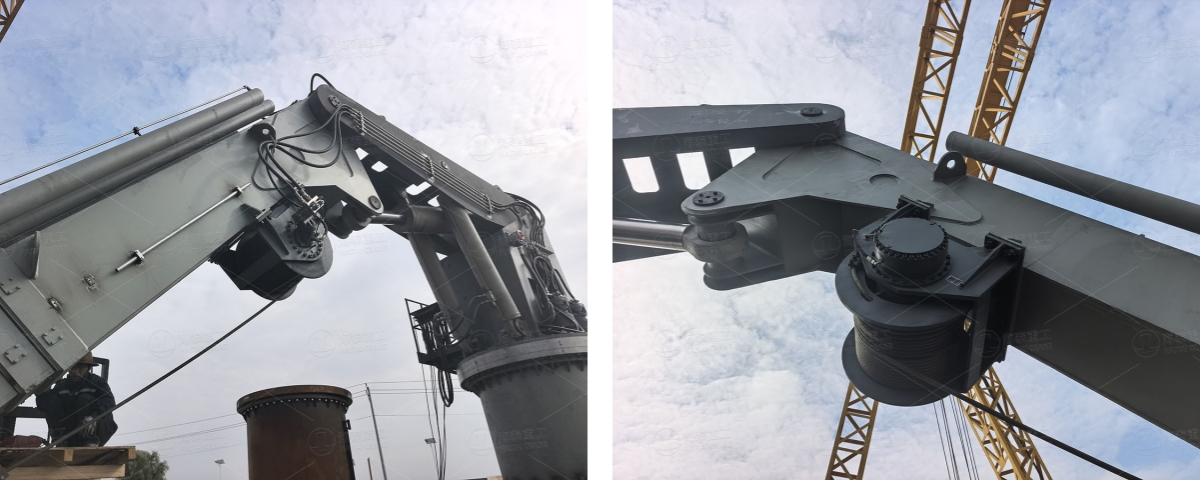
The boom is one of the main structural components responsible for supporting and transferring lifting loads on a marine crane. Its length, extension configuration, luffing angle and cross-sectional design all affect how the crane is loaded at different working radii.
For a telescopic boom marine crane, extending the boom allows it to reach farther working positions, but it also changes the forces acting on the boom itself. In addition to the suspended load, the boom must withstand its own weight, bending stresses and other related loads. As the boom extends farther, controlling structural deflection and stress becomes increasingly important.
The boom angle also affects the actual working radius. At different boom angles, the horizontal distance between the suspended load and the slewing center may vary even when the boom length remains unchanged. Therefore, the crane’s lifting capacity cannot be determined simply by looking at how far the boom has extended.
Different types of marine cranes also have different structural designs. Straight boom marine cranes, Telescopic boom marine cranes and knuckle boom marine cranes have different structural characteristics and operating mechanisms. Their lifting capacities must be determined according to their specific designs and working ranges.
For hydraulic marine cranes, the hydraulic system powers boom luffing, telescoping, slewing and hoisting operations. System pressure, hydraulic cylinder dimensions, pump flow capacity and the compatibility of individual components all affect the crane’s operating capability and performance.
The boom luffing cylinder must generate sufficient force to hold or move the boom at different angles. As the boom extends and the working radius increases, changes in the moments generated by the boom and suspended load affect the forces that the cylinder needs to withstand.
The hydraulic system must provide the required force within its designed pressure range while ensuring that the cylinders, hydraulic lines and valve assemblies can withstand pressure variations during continuous operation. Its capacity must be matched to the boom structure and the overall crane design. Increasing system pressure alone is not a suitable way to increase lifting capacity.
After prolonged operation, hydraulic oil condition, seal performance, component wear and abnormal system pressure may also affect the crane’s operating performance. Regular inspection and maintenance of the hydraulic system are therefore important for keeping the crane in proper working condition.
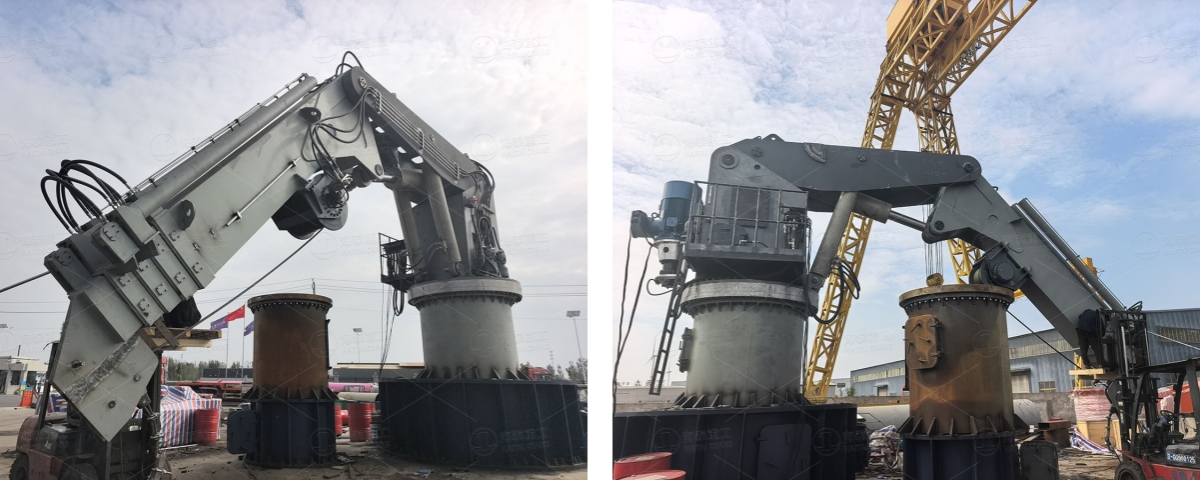
The lifting capacity of a marine crane is not determined by the boom alone. Forces generated by the suspended load are transferred through the boom, slewing bearing, crane body, base and mounting structure to the vessel’s deck or other supporting components. Every critical component along this load path must meet the required strength and load-bearing standards.
As the working radius increases, the overturning moment acting on the crane generally increases as well. This affects not only the boom but also places greater forces on the slewing bearing, connecting components and crane base. The crane design must account for the load-bearing capacity of these components under different boom positions and lifting conditions.
Even if the hydraulic system can generate sufficient lifting force, this does not mean the crane can lift the corresponding load at any working radius. The allowable load is ultimately limited by the overall structural design and the crane’s rated load specifications.
Unlike land-based cranes, the lifting capacity of a marine crane is also affected by the vessel’s stability and installation conditions. When the crane lifts a load, the load weight and its distance from the vessel’s centerline change the vessel’s overall loading condition and may affect its heel, trim and center of gravity.
When the crane extends toward one side of the vessel and lifts a load, the suspended load may create an additional overturning moment on the vessel. This effect generally becomes more pronounced as the load weight increases or the working radius becomes larger. For smaller workboats, vessels with limited deck space or vessels that are particularly sensitive to changes in center of gravity, stability may become an important factor limiting lifting capacity.
The crane’s installation position also affects its actual operating capability. When installed at different locations on a vessel, the suspended load may have different effects on the vessel’s overall center of gravity and stability. The deck structure, mounting foundation and supporting structure beneath the crane must also be capable of meeting the lifting requirements.
Therefore, when designing a marine crane, it is not enough to calculate the crane’s own load-bearing capacity. The vessel’s displacement, stability conditions, deck structure and crane installation position must also be evaluated together.
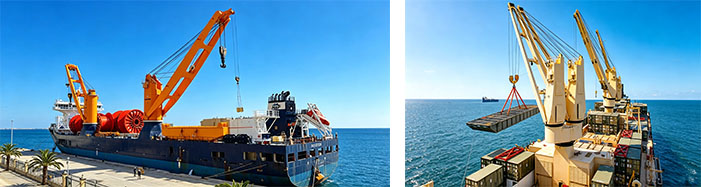
The actual operating environment of a marine crane is often affected by wind, waves and vessel motion. Unlike relatively stable lifting conditions on land, vessels may experience roll, pitch and heave while operating at sea. These movements can introduce additional dynamic forces acting on both the suspended load and the crane.
Wind load is one of the factors that needs to be considered. As the boom extends, the crane’s exposed area may increase. For loads with large dimensions or irregular shapes, wind may also cause the cargo to shift or swing. When the load is farther away from the crane’s slewing center, swinging can make the operation more difficult and affect positioning and control during lifting.
Vessel motion can also change the actual forces acting on the suspended load. When the vessel rolls or pitches, the load may move relative to the crane, causing variations in the forces acting on the hoisting rope and related structural components. In some cases, dynamic loads may exceed those experienced under static conditions.
For this reason, operating limits for marine cranes are generally not based solely on rated lifting capacity and working radius. They may also include restrictions on wind speed, sea conditions, load swing and equipment operating status. During actual lifting operations, whether it is safe to continue should be assessed according to the operating conditions specified by the manufacturer.
The load chart is an important reference for determining the allowable lifting capacity of a marine crane at different working radii and boom configurations. For purchasing personnel, marine engineers and crane operators, understanding how to read a load chart is more practical than simply remembering the crane’s maximum tonnage.
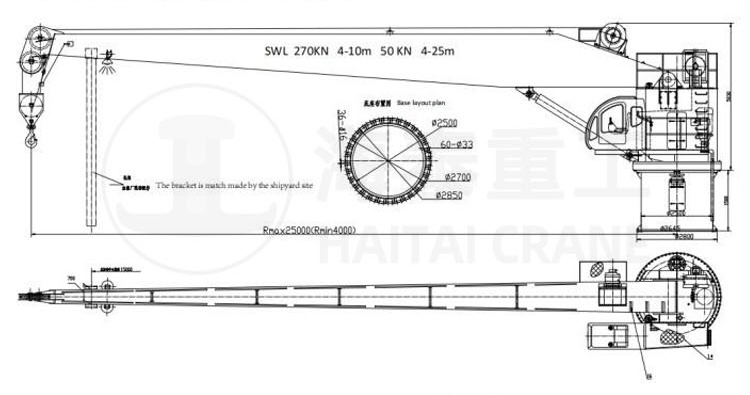
A load chart typically lists the allowable lifting loads at different working radii. The rated lifting capacity may change as the working radius increases or decreases. Some cranes also provide different load data according to boom length, extension configuration or other equipment settings.
When reading the load chart, first identify the current or planned working radius and then check the corresponding allowable load. The maximum rated lifting capacity shown on the crane’s nameplate cannot be applied to every lifting position.
For example, a marine crane may have a maximum rated lifting capacity of 10 tons, but this capacity may only be available at a specific boom angle or within a relatively small working radius. If the lifting position requires the boom to reach farther out, the actual allowable load may be lower than 10 tons.
When purchasing a marine crane, it is advisable to focus on its lifting capacity at commonly used working radii rather than asking only about its maximum tonnage.
The load chart data must correspond to the crane’s actual configuration. For a telescopic boom crane, different boom extension lengths may result in different load capacities. For other types of marine cranes, boom angle, operating position and equipment configuration may also affect load limits.
If the crane is equipped with different hooks, lifting devices or attachments, their weight and any applicable operating restrictions must also be taken into account according to the manufacturer’s requirements.
In addition, load charts are generally developed based on specific design and operating conditions. If vessel stability, wind speed or other site conditions do not meet the equipment requirements, lifting operations should not be planned solely based on the load chart values.
The allowable lifting load at different working radii is affected by several factors, including structural loading, hydraulic system capability, boom angle, equipment configuration and safety limits. Even two cranes with similar boom lengths may have significantly different load charts.
Load charts are established based on equipment design, engineering calculations and relevant verification. They should not be replaced by simple mathematical estimates or proportional calculations. For operating conditions beyond the load chart’s range, or conditions not clearly specified in the chart, the manufacturer should be consulted instead of estimating the allowable load independently.
For customers preparing to purchase a marine crane, identifying the maximum lifting load is only part of the selection process. Where the crane needs to pick up the load, where it needs to move the load, and whether it can cover the entire working area are equally important when determining the final configuration.
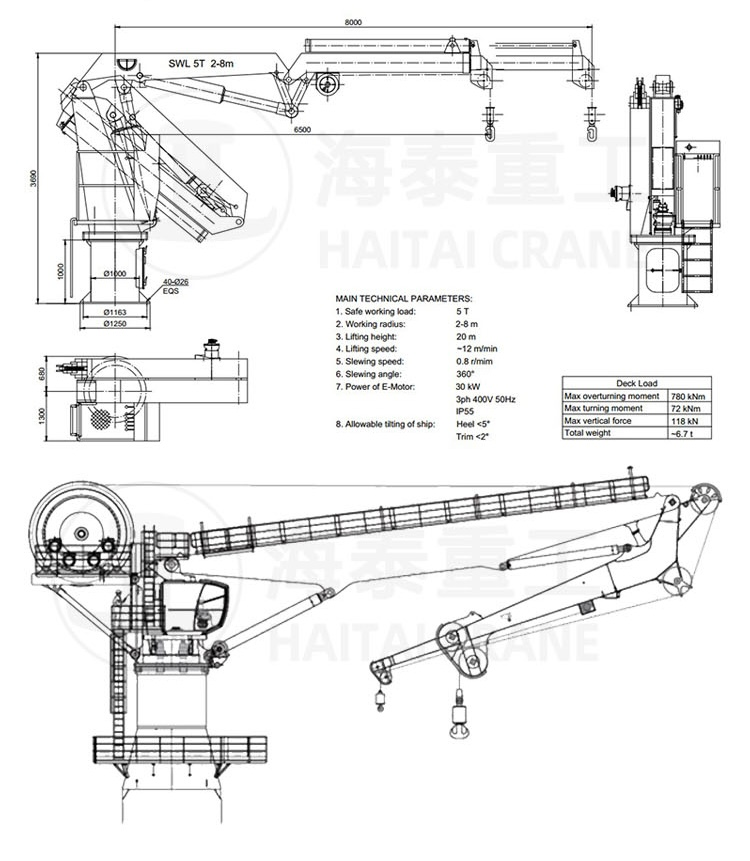
Before purchasing, the vessel’s typical lifting requirements should be reviewed, including machinery components, maintenance equipment, supplies, marine accessories and other items that need to be handled or transferred.
In addition to the weight of the cargo itself, the weight of hooks, slings, lifting beams and other lifting accessories should be considered, along with any additional loads involved in the actual lifting operation. The size, shape and center of gravity of different loads may also affect the lifting method.
If the crane is mainly used for light lifting during routine operations but occasionally needs to handle heavier equipment, these special lifting tasks should also be included in the selection requirements rather than determining the crane’s tonnage solely based on the average daily load.
The working radius should be determined according to the vessel’s layout and actual lifting positions. The crane installation location, deck equipment arrangement, distance from the vessel’s side, and cargo pickup and landing positions all affect the required working range.
If the crane only needs to lift cargo in areas close to its installation position, a relatively small working radius may be sufficient. However, if it needs to pick up loads from the opposite side of the vessel or transfer cargo over a certain distance to a dock, another vessel or a designated location, it is necessary to confirm whether the crane can handle the required load at a larger working radius.
A larger working radius is not always better. Pursuing an unnecessarily wide working range may increase the requirements for boom structure, equipment dimensions and overall configuration. A more practical approach is to determine the working radius based on actual lifting positions and avoid mismatches between the crane configuration and site requirements.
After determining the maximum lifting load and required working radius, both parameters need to be considered together to assess whether the crane is suitable.
For example, if a customer needs to lift a 5ton load at a working radius of 8 meters, the selection process should not focus only on whether the crane has a maximum rated lifting capacity of 5 tons. It is necessary to confirm that the crane can still lift the required load at an 8meter working radius.
If the crane achieves its maximum rated lifting capacity at a smaller working radius but cannot lift 5 tons at an 8meter radius, it will not meet the project’s actual requirements, even if its nameplate indicates a rated lifting capacity of 5 tons.
Therefore, before purchasing, customers should provide the maximum lifting load, commonly used lifting positions, required working radius range and vessel installation conditions. Based on this information, the manufacturer can determine whether the boom length, structural design, hydraulic configuration and other equipment parameters are suitable for the actual operation.
For vessels that need to handle loads at multiple lifting positions, it is advisable to organize the lifting requirements for each position into clearly defined operating conditions rather than providing only a single maximum tonnage. This makes it easier to evaluate the crane’s load capacity throughout its entire working range.
When purchasing a marine crane, the maximum rated lifting capacity is often the first parameter customers look at. However, this figure alone does not fully represent the crane’s actual operating capability.
A crane may have a high lifting capacity at a smaller working radius, but when the boom extends over the side of the vessel or reaches farther out to another working position, its allowable load may no longer meet the requirements. If the load capacity at the corresponding radius is not checked during the purchasing process, the crane may not be able to cover the expected lifting range after installation.
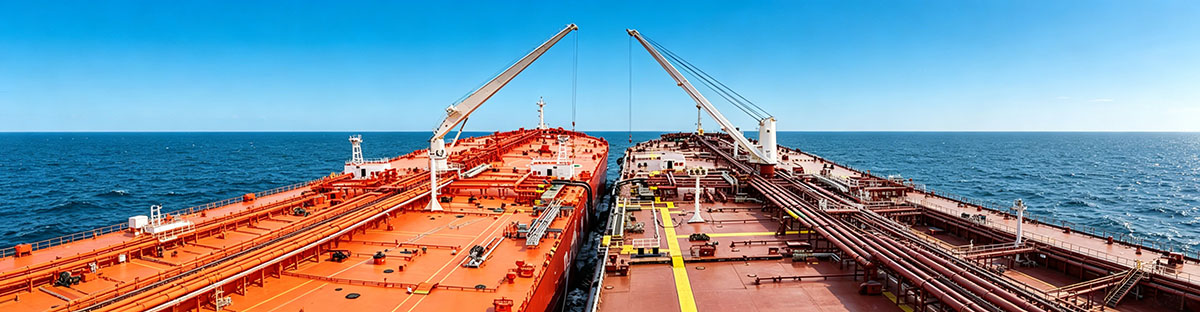
For vessels that require frequent lifting, load transfer between multiple positions or operations over a relatively wide area, it is advisable to pay particular attention to lifting capacity at commonly used working radii, load performance at the maximum working radius, boom structure and equipment configuration, as well as vessel installation conditions and the actual operating environment.
Crane design should take the entire working range into account. Only when the equipment can meet the lifting requirements at both commonly used and maximum working radii can it truly accommodate the vessel’s daily operating needs.
The lifting capacity of a marine crane at different working radii is affected by several factors, including load moment, boom length and angle, hydraulic system capability, structural load limits, vessel stability and the actual operating environment. An increase in working radius generally results in a greater load moment, which often requires a corresponding reduction in allowable lifting capacity. However, the actual change depends on the crane’s design and load chart.
For customers purchasing a marine crane, the maximum rated lifting capacity is only the starting point for equipment selection. What really needs to be confirmed is whether the crane can lift the specified load at the required working radius while meeting the vessel’s installation requirements and actual operating conditions.
Haitai Crane can provide marine crane designs and customized solutions based on the customer’s lifting requirements, working radius, vessel deck layout and actual operating conditions. Defining these parameters in advance helps customers select a crane configuration that better suits their vessel’s operational needs.