At marinas, yacht clubs, and shipyards, reliable lifting equipment is essential for launching boats, hauling them out of the water, moving them around the yard, as well as maintenance and storage. With its rubber-tired travel system and flexible lifting slings, a mobile boat hoist can move between different working areas with ease, making it a widely used piece of equipment for boat handling and maintenance on land.
Unlike fixed lifting equipment, a mobile boat hoist does not rely on permanent rails or large fixed foundations. It can be configured according to the boat’s dimensions, weight, and working conditions, making it suitable for lifting, transporting, and positioning yachts, workboats, and other types of vessels.
So, how does a mobile boat hoist complete the entire boat handling process? What are its main components? And how should the right equipment be selected for different types of boats and working sites? This article provides a detailed overview of its working principle, operating process, key components, vessel compatibility, selection considerations, and safety requirements.
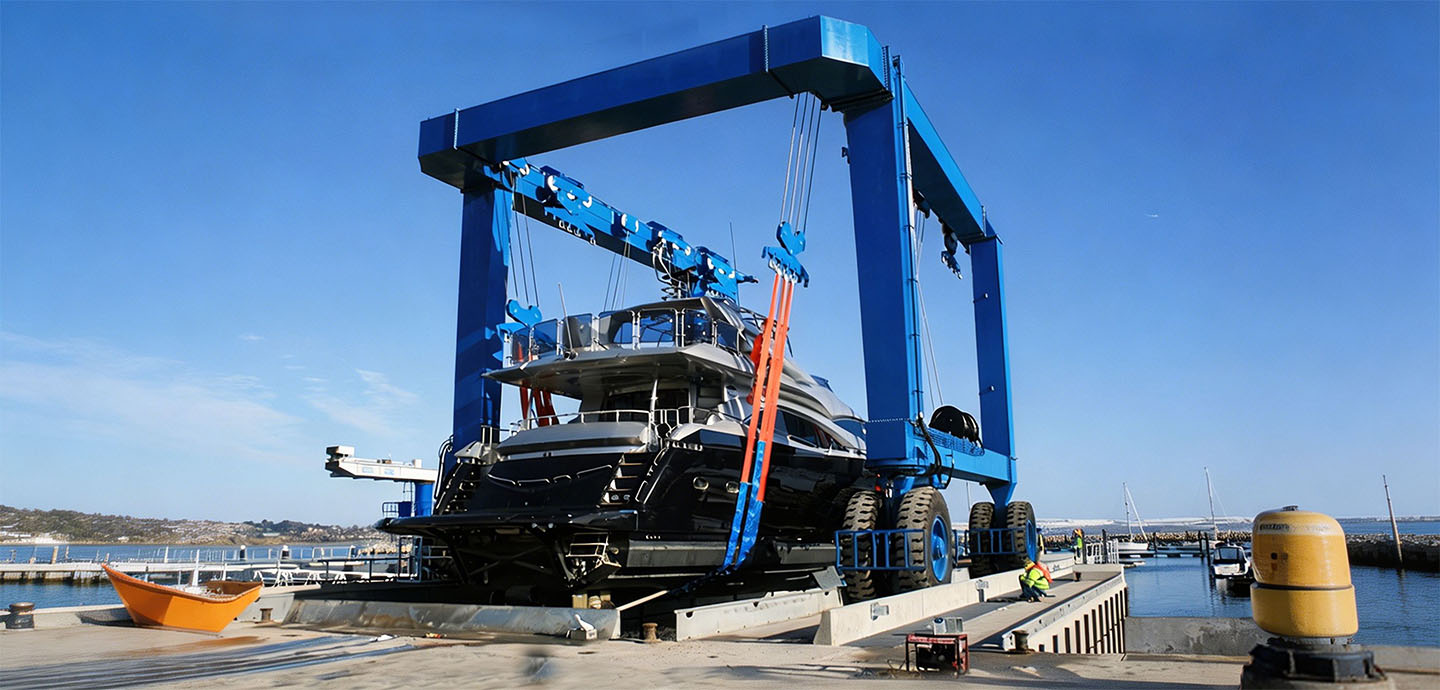
A mobile boat hoist, also commonly referred to in the industry as a mobile marine travel lift, boat hoist, or mobile boat lift, is a type of mobile lifting equipment specifically designed for handling boats on land. Unlike conventional fixed cranes and gantry cranes, this type of equipment is normally equipped with a rubber-tired travel system, eliminating the need for permanent rails and allowing it to move around suitable working areas as required.
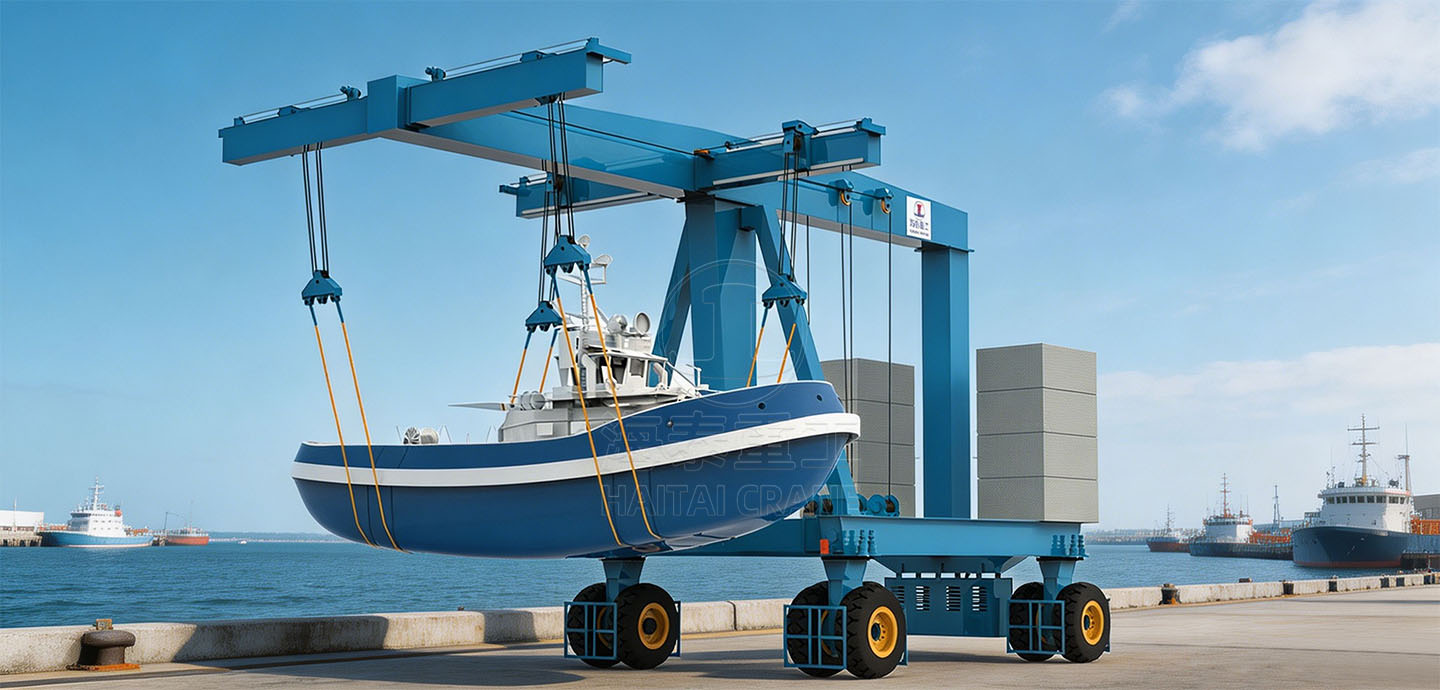
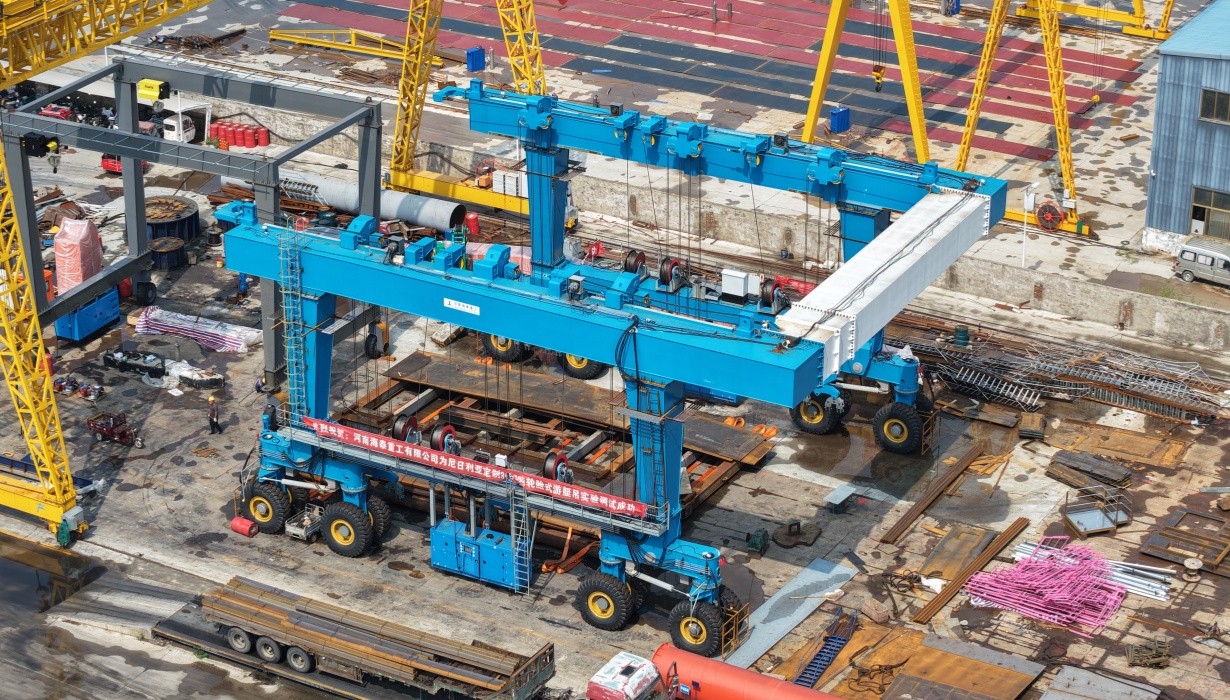
The main structure is typically built as a gantry frame and fitted with flexible lifting slings and a hydraulic lifting system. During operation, the slings support the boat from underneath the hull, while the hydraulic system raises and lowers the vessel. The travel and steering systems then allow the boat to be moved to the required position within the yard.
The design of a mobile boat hoist focuses not only on lifting capacity but also on protecting the hull and providing flexibility in different working areas. Flexible slings can reduce the impact of rigid contact on the hull and its paintwork, while the mobile structure allows the equipment to adapt to different boat handling positions.
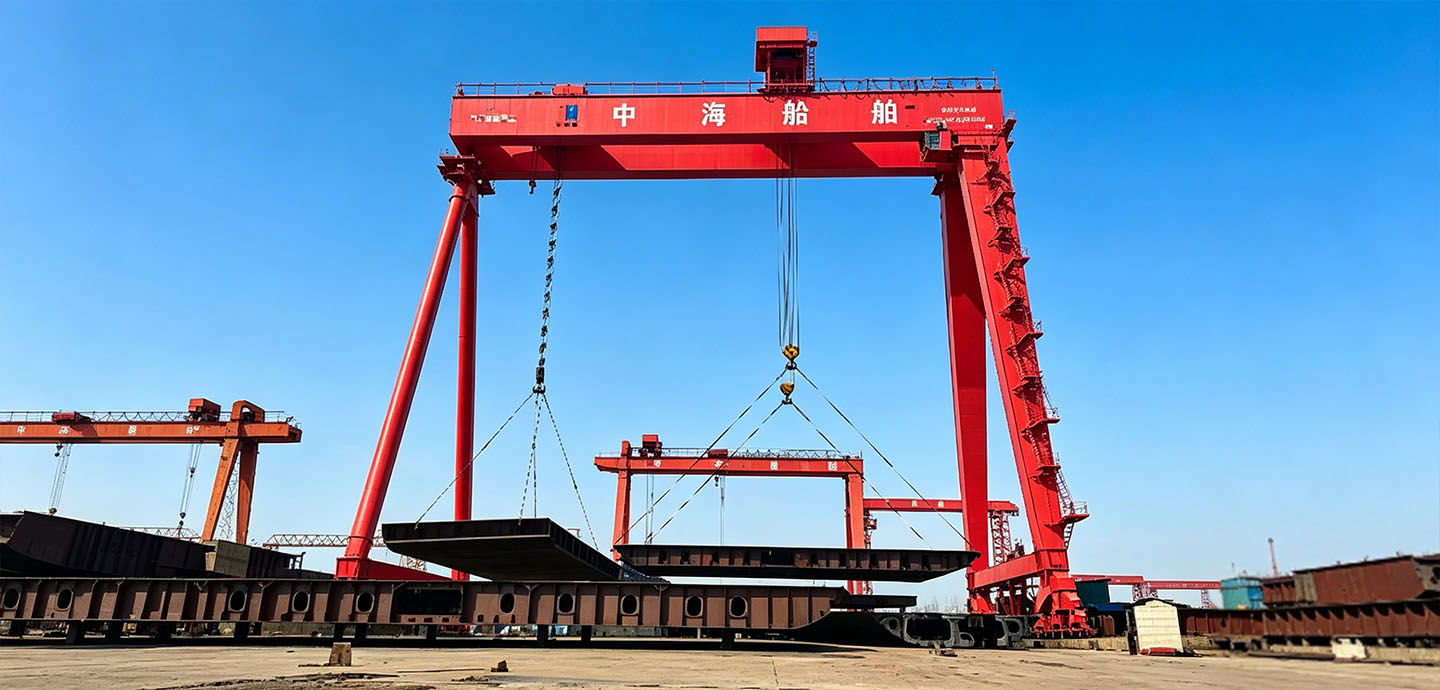
Fixed gantry cranes, shore-based fixed cranes, and rail mounted gantry cranes are generally installed in predetermined locations, with their operating range limited by the rails, foundations, and installation position. A mobile boat hoist, on the other hand, travels around the site on rubber tires, making it more suitable for applications where the position of the boat needs to be changed frequently.
In terms of vessel compatibility, fixed equipment is generally designed around a specific operating range. A mobile boat hoist can be configured according to the boat’s weight, width, height, and hull structure, allowing the equipment span, lifting height, and sling arrangement to be adjusted accordingly.
In terms of infrastructure, fixed equipment normally requires dedicated rails or foundations. A mobile boat hoist does not depend on permanent rails, although the working area still needs to provide sufficient ground bearing capacity, a reasonably level surface, and enough space for operation.
Therefore, the two types of equipment are not simply alternatives to each other. They are designed for different boat handling and lifting applications, with the choice depending on the specific requirements of the vessel and the working site.
The working process of a mobile boat hoist can be summarized as follows: pre-operation inspection, equipment positioning, sling placement, smooth lifting, low-speed transportation, precise lowering and positioning, and sling release.
The entire process requires the hydraulic lifting system, slings, travel system, steering system, and control system to work together. The specific process is as follows.
Before lifting begins, the boat’s weight, center of gravity, and basic dimensions should first be confirmed, and the rated capacity of the equipment should be checked to ensure that it meets the requirements of the current operation.
The condition of the slings, hydraulic system, tires, braking system, control system, and safety devices should also be checked. The travel route and working area should be inspected for any obvious obstacles, while the ground bearing capacity and site conditions should be confirmed to meet the requirements for safe operation.
After the inspection is completed, the operator drives the mobile boat hoist to the area near the boat and adjusts its position and direction according to the location of the hull, ensuring that the boat is within the effective working area of the main frame.
A suitable safety clearance should be maintained between the equipment and the hull to prevent collisions during lifting and travel. The appropriate lifting positions should also be determined based on the boat’s width, height, and sling arrangement.
Once the equipment is properly positioned, the flexible lifting slings are passed underneath the hull. Their positions are determined according to the boat’s length, width, center of gravity, and bottom structure.
Different types of boats have different load-bearing characteristics. Flat-bottom boats generally have a relatively large bottom support area, while deep-V hulls, keel sailboats, and catamarans may have more concentrated support points. The slings therefore need to be arranged according to the specific hull structure.
After the slings are installed, they should be checked for twisting, displacement, or damage. The contact points between the slings and the hull should also be properly positioned so that the load can be distributed as evenly as possible across the designed support points.
Once the sling arrangement and equipment condition have been confirmed, the hydraulic lifting system is activated to raise the boat.
The hydraulic system drives the slings upward through hydraulic cylinders, gradually lifting the hull clear of the water, ground, or supporting structure. During lifting, the movement should remain smooth while the operator monitors the boat’s attitude, sling positions, and equipment load conditions.
A small test lift is normally carried out first, allowing the slings to gradually take the load. Once it has been confirmed that the boat has no obvious inclination, the slings have not shifted, and the equipment is operating normally, the lifting process can continue to the required height.
The key during lifting is not simply to achieve a higher speed, but to keep the load stable and the boat’s position under control.
Once the hull has been raised high enough to safely clear ground obstacles, the travel system can be activated to move the boat.
The mobile boat hoist uses its rubber-tired travel mechanism to move forward, backward, and turn, while allowing low-speed adjustments according to site conditions. In confined working areas such as shipyards and yacht clubs, the travel route should be planned in advance, with the travel speed controlled according to the available site width and turning space.
During transportation, sudden acceleration, hard braking, and sharp turns should be avoided as much as possible to reduce hull movement and changes in the load.
Once the equipment reaches the target area, its position is first adjusted so that the boat is accurately aligned with the storage supports, keel blocks, or launching area.
The hydraulic lifting system then slowly lowers the hull. As the boat approaches the supporting structure, the lowering speed should be reduced further, with fine adjustments made according to the actual position so that the hull can be placed smoothly.
When the equipment is used for launching, the hull is gradually lowered toward the water. Once the boat’s buoyancy begins to support most of its weight, the load on the slings can then be gradually released.
When the boat is being stored on land, it is important to ensure that the hull finally rests on the designated support points, with the supporting structure properly aligned with the load-bearing areas of the hull.
Once it has been confirmed that the boat is stably supported by the water or the supporting structure, the load on the slings is gradually released and the slings are removed from underneath the hull.
After the slings have been removed, the equipment is driven away from the boat handling area, and the relevant components are returned to their required positions according to the equipment operating procedures. This completes the boat lifting and transportation process.
A mobile boat hoist relies on the coordinated operation of the main frame, hydraulic lifting system, lifting slings and lifting mechanism, travel and steering system, control system, and safety devices to complete the operating processes described above.
The main frame is the primary load-bearing structure of the equipment and is typically manufactured from high-strength structural components to form a gantry-style frame.
The frame carries the weight of the boat and the associated lifting loads, while also connecting the lifting system, travel system, and related control components. The equipment span and height can be designed according to the boat’s dimensions and operating conditions, ensuring that the hull can be lifted and transported safely within the frame.
The hydraulic lifting system is the core component responsible for the lifting and lowering movements of a mobile boat hoist. It typically includes a hydraulic power unit, hydraulic cylinders, piping, valve assemblies, and related control components.
The hydraulic system supplies power to the lifting mechanism, with the extension and retraction of the hydraulic cylinders driving the slings to raise and lower the hull. For multi-point lifting systems, synchronized control is required to coordinate the movement of different lifting points and reduce hull inclination and uneven load distribution.
The lifting slings are the load-bearing components that come directly into contact with the hull. Flexible slings with sufficient load-bearing capacity are generally used to reduce rigid contact with the hull surface and structure.
The lifting mechanism connects to and controls the slings. Their positions can be adjusted according to the boat’s dimensions, center of gravity, and bottom structure, allowing the load to be distributed as evenly as possible across suitable support points.
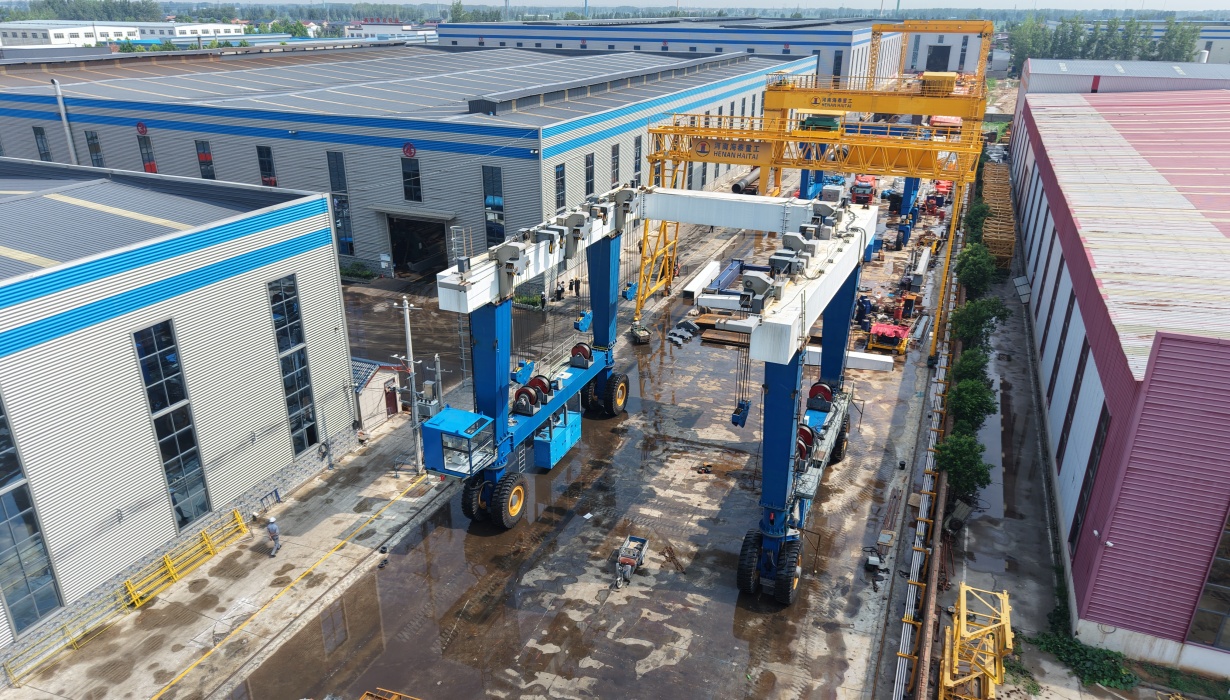
The travel system allows the equipment to move around the working area and generally consists of tires, drive mechanisms, transmission systems, and steering mechanisms.
Different travel and steering configurations can be provided according to the equipment design and project requirements, allowing the mobile boat hoist to operate in open shipyards, marinas, and boat storage areas where working space may be limited.
The control system coordinates the equipment’s lifting, travel, steering, starting, and stopping operations. The operator can control the equipment from the driver’s cab or through a control device that meets the equipment’s design requirements.
For boat handling operations that require precise positioning, the control system needs to support low-speed travel and fine adjustments, allowing the equipment to carry out lifting, transportation, and positioning operations with greater accuracy.
Mobile boat hoists are typically equipped with various safety protection devices, such as overload protection, emergency stop systems, lifting limit switches, hydraulic safety protection, warning devices, and load monitoring systems.
The specific safety configuration should be determined according to the equipment model, project requirements, and applicable standards. These systems help operators monitor the operating condition of the equipment and take appropriate shutdown or protective measures when an abnormal situation occurs.
Boats can vary considerably in weight, dimensions, hull shape, and center of gravity. Therefore, equipment selection should not be based solely on the rated lifting capacity. The actual hull structure and operating conditions also need to be taken into consideration.
A mobile boat hoist can be designed according to the maximum boat weight, hull width, height, and actual operating requirements.
The rated lifting capacity, frame span, lifting height, and tire load capacity all need to match the target boat. The equipment must not only meet the maximum load requirements but also provide sufficient clearance for the hull to be safely lifted and transported within the frame.
Flat-bottom boats, deep-V hulls, keel sailboats, and catamarans have different bottom structures, so their sling arrangements may also vary.
During actual operation, the number and positions of the slings need to be determined according to the hull structure, load-bearing areas, and center of gravity. For special types of boats, the appropriate support arrangement should also be determined based on the manufacturer’s requirements or the specific hull structure.
When lifting a boat, its total weight is not the only consideration. The position of the center of gravity also affects lifting stability.
If the engine, equipment, or other loads on the boat are concentrated toward the bow or stern, the overall center of gravity may shift. In such cases, the sling arrangement and lifting method need to be adjusted according to the actual center of gravity so that the load remains reasonably distributed among the different lifting points.
In addition to sling positions, the equipment span, lifting height, travel speed, steering configuration, and control system can also be designed according to project requirements.
For maintenance work and precise positioning, particular attention can be given to low-speed travel and fine adjustment capabilities. For frequent boat transportation, the travel and hydraulic systems can be configured according to the actual operating conditions.
Mobile boat hoists are mainly used in locations where boats need to be lifted, transported, and stored on a regular basis.
Yacht clubs and marinas commonly need to handle boat launching, hauling out, short-distance transportation, and seasonal storage. A mobile boat hoist can flexibly adjust the position of boats according to site conditions, making it suitable for a range of routine boat handling tasks.
Shipyards often need to move boats during construction, maintenance, modification, and delivery. Mobile equipment can reduce dependence on fixed rails and can be adjusted according to different boats and working positions.
Maintenance facilities typically handle boats of different sizes and weights. A mobile boat hoist can be used to haul boats out of the water for inspection and repair, relaunch them after maintenance, and transport them around the facility.
In boat storage areas, the equipment can move boats to designated support positions, helping make better use of the available space while providing greater flexibility for boat access and storage.
For facilities that provide a combination of cleaning, maintenance, repair, storage, and delivery services, a mobile boat hoist can handle boat transportation across multiple stages of the operation.
Proper equipment selection should take into account the boat’s specifications, working site, and frequency of use rather than simply choosing equipment with a higher lifting capacity or more advanced configuration.
The first step is to determine the maximum boat weight that needs to be handled at the site and select an appropriate rated lifting capacity based on the actual operating conditions.
In addition to the boat’s own weight, equipment, fuel, water, and other additional loads that may be on board should also be considered. The specific safety margin should be determined according to the equipment design standards and project requirements.
The span and height of the equipment frame need to match the dimensions of the largest boat, while allowing sufficient operating clearance.
If the boat width is close to the effective span of the equipment, it may affect sling arrangement and equipment travel. Therefore, boat width, boat height, and the actual operating space should all be considered during equipment selection.
The required lifting height should be determined according to the specific operating tasks.
If the equipment is mainly used for launching, hauling out, and transportation on land, the lifting height generally needs to provide sufficient clearance between the hull bottom and the ground, as well as enough space to pass obstacles. If the boat also needs to be placed on elevated supports or handled in other special transportation operations, the required lifting height needs to be calculated accordingly.
Ground bearing capacity is an important factor in selecting a mobile boat hoist.
During full-load operation, the ground needs to withstand the pressure generated by the equipment’s own weight and the boat load transmitted through the tires. Therefore, the ground bearing capacity, levelness, slope, uneven areas, and obstacles along the travel route need to be assessed.
Common paved areas at marinas and shipyards can often be used as working areas, but whether they actually meet the requirements needs to be confirmed based on the total equipment weight, boat load, and actual ground conditions.
If the working area is relatively narrow or boats are stored close together, particular attention should be paid to the equipment’s steering configuration, minimum turning space, and low-speed fine adjustment capability.
For larger shipyards with more available space, the appropriate travel configuration can be selected according to the transportation distance and frequency of operation.
The power and hydraulic systems need to be configured according to the equipment capacity, frequency of use, working environment, and the customer’s operating requirements.
For equipment used frequently or in demanding environments, particular attention should be given to the reliability of the hydraulic system, heat dissipation, ease of maintenance, and how well the power system matches the overall equipment design.
Export projects and boat handling applications in different regions may be subject to different regulations and technical standards. During equipment selection, the requirements of the project location should be checked to determine whether certifications or inspections such as CE, BV, DNV, ABS, or CCS are required.
The specific scope of certification should be determined according to the equipment type, region of use, and project requirements.
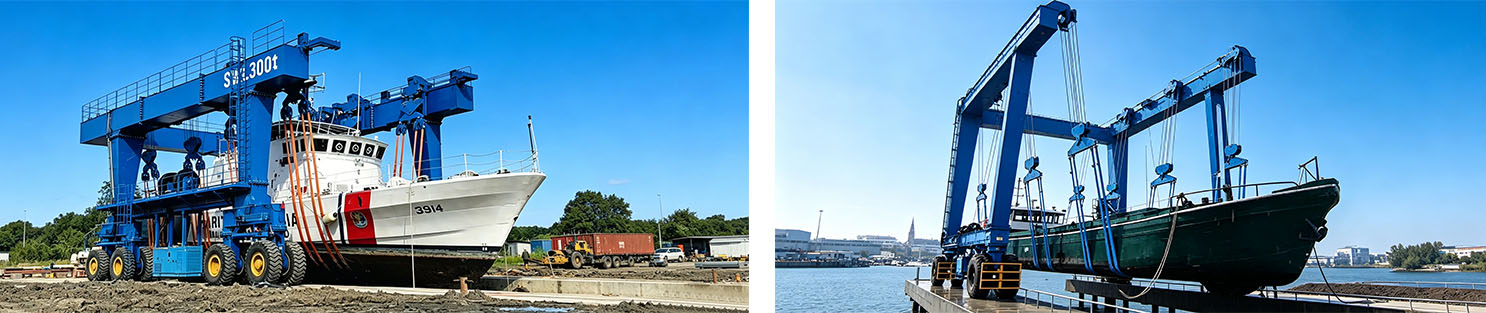
Boat lifting crane involves substantial loads and mobile operations. Equipment inspection, sling arrangement, load control, and on-site operation are all important factors in maintaining safe working conditions.
Before operation, the actual weight and center of gravity of the boat should be confirmed, and the rated capacity of the equipment should be sufficient for the current operation.
For boats with a significantly offset center of gravity, the sling positions and lifting method should be adjusted according to the actual conditions.
Before each operation, inspect the slings for visible wear, cracking, deformation, or other abnormalities. Any sling that does not meet the requirements for use should be replaced promptly in accordance with the relevant management procedures.
The attitude of the hull and the condition of the slings should be continuously monitored during lifting, transportation, and lowering.
If significant tilting, sling displacement, or abnormal load conditions are detected, the operation should be stopped and the cause identified. Transportation should not continue while the equipment or load is in an abnormal condition.
A suspended boat has a certain amount of inertia. Therefore, sudden acceleration, hard braking, and sharp turns should be avoided during travel, with smooth operation maintained as much as possible.
Before transportation, the entire travel route should be inspected, avoiding obvious potholes, soft ground, standing water, and sections that are unsuitable for carrying the load.
If the route has significant slopes or special ground conditions, a dedicated assessment should be carried out before operation.
During lifting and transportation, the working area should be controlled according to site safety requirements to prevent unauthorized personnel from entering hazardous areas around the equipment and boat.
No personnel should be allowed to remain or pass underneath the suspended hull.
Operators should receive appropriate training and carry out operations in accordance with the operating instructions provided by the equipment manufacturer.
Overloading, unauthorized modification of the equipment structure, and bypassing or disabling safety protection devices are not permitted. Routine maintenance and periodic inspections should also be carried out according to the equipment maintenance requirements.
Boat types, site conditions, and operating methods can vary considerably between shipyards, marinas, and boat maintenance facilities. Therefore, mobile boat hoists generally need to be configured according to the actual working conditions.
The equipment’s rated lifting capacity should be determined according to the common boat types handled at the site and the maximum operating load, ensuring that the equipment capacity matches the actual requirements.
The equipment span, overall dimensions, and lifting height should be determined according to the boat width, available working space, and travel routes, allowing the equipment to operate within the existing site conditions.
Depending on the actual operating requirements, the sling arrangement, travel configuration, steering method, control system, and hydraulic configuration can be adjusted accordingly.
If the equipment is used for extended periods in coastal areas, high-salt-spray environments, or high-frequency operating conditions, factors such as structural corrosion protection, component protection, and other durability-related configurations should also be considered based on the working environment.
A mobile boat hoist is mainly used for boat launching, hauling out, transportation within the yard, maintenance, storage, and positioning. It is commonly used at yacht clubs, marinas, shipyards, and boat maintenance facilities.
The equipment supports the hull with flexible lifting slings and uses a hydraulic lifting system to drive multiple lifting points up and down in synchronization, allowing the boat to be raised smoothly to the required height. The actual sling positions and lifting method need to be determined according to the boat’s hull structure and center of gravity.
Mobile boat hoists can be designed with different rated lifting capacities. The specific equipment capacity needs to be determined according to the maximum boat weight, dimensions, center of gravity, working site, and operating requirements.
Yes. When the ground bearing capacity, levelness, and other operating conditions meet the requirements, the equipment can use its rubber-tired travel system to move boats forward, turn, and transport them within the working area.
Yes. The rated lifting capacity, frame span, lifting height, sling configuration, travel and steering methods, power system, and hydraulic system can all be designed according to specific project requirements.
There is no single standard boat size. The applicable range depends on the equipment’s rated lifting capacity, frame span, lifting height, sling arrangement, as well as the boat’s own dimensions and weight.
The working ground generally needs to have sufficient load-bearing capacity and be relatively level and firm. The actual requirements need to be assessed based on the total equipment weight, boat load, tire loads, site slope, and travel conditions.
A mobile boat hoist completes boat lifting, launching, hauling out, transportation, and positioning through the coordinated operation of its hydraulic lifting, sling support, travel, and steering systems. In actual operation, equipment performance depends not only on its rated lifting capacity but is also closely related to the boat’s dimensions, center of gravity, lifting height, ground conditions, and working environment.
Therefore, when selecting a mobile boat hoist, the specific boat and working conditions should be considered rather than relying on a single equipment parameter. For boats with different lifting capacities and operating requirements, the equipment can be designed accordingly in terms of load capacity, equipment dimensions, sling configuration, travel and steering methods, and other key parameters.